

Prior to 1870 the settlers received their world news from Sydney newspapers with no local content except via the occasional visiting correspondent. These men came to the district for a short time, made crude observations and then published 3000 words in the Sydney Morning Herald about the hospitality they had received from one of the larger stations.
The Clarence and Richmond Examiner was launched in Grafton in 1859, backed by the wealthy landowner Clarke Irving. This was the only representation of local issues until 1870 when The Richmond River Express was published in Casino. Four major newspapers emerged covering the larger towns Coraki, Ballina, Lismore and Casino – reporting on local politics, events, shipping movements and building developments.
The early newspapers were little more than propaganda sheets for whichever politician, or would-be politician, wanted to express their views or proselytizing from a particular religious pulpit. They were highly criticized for their bias and often supported issues benefitting their wealthy owners or secular beliefs rather than progressive ideas for the district.
“The Press wields a great power, and manly criticism is invaluable, but the high standard of the Press is being dragged down very low by writers who descend to falsehood, and it is not to be wondered at that some of the public men of Lismore are raising the cry. “Regenerate the Press!”
With much of their copy coming from town gossip, hearsay and innuendo, and freely publishing “Letters to the Editor” with little oversight or fact-checking, newspaper editors were frequently charged with libel and were called upon to defend themselves and their scribes in court.
Sometimes, much to the amusement of their subscribers, the tit-for-tat games would play out amongst the rival editors themselves, and as most papers were only published weekly, this serial drama could stretch over several weeks or months. Scandal sells!
“Ballina people were much interested in the case which was set down for hearing at the last District Court, and in which Mr. Temperley, Richmond River Express (sic), sued Mr. G. Pinchin, of the Ballina Pilot, for £200 damages for alleged libel contained in letters written to the Editor of the Pilot…. those “who know” expected some very entertaining revelations from the evidence. As the plaintiff accepted £15 in settlement of his claim, and no public apology was conceded, it can hardly be said that there was a glorious victory in the case, but the greedy eared public had no opportunity of listening to evidence which, as the Judge hinted, would amount to a “washing of dirty linen.”
As the towns grew, so did the volume and frequency of the papers. Much of their income relied on advertising and subscriptions but they also supplemented this with “job printing” – cards, invitations, flyers etc.
With frequent buy-outs, name changes and amalgamations, it is difficult to keep track of all the smaller papers that came and went over the next century.

Richmond River Express 1870 – 2020

Robert Gordon Balmer, former editor of the Clarence and Richmond Examiner, moved up from Grafton in 1870 and established the Richmond River Express and Tweed Advertiser in Casino – still considered a bush village without banks, churches or telegraph line.
A small rival newspaper The Representative and Advocate was set up by Messrs. Simpson and The Express was sold at auction in 1878 to John Craigie, son of Walter Craigie, joint proprietor of the Armidale Express, for £337. The price indicated the low level of profits expected. Craigie bought out his rival and amalgamated the two papers.

The Express was sold again in the early 1880s to Mr Robert Page from the Grafton Argus. For the next 28 years the Express enjoyed Page’s stewardship. He and his wife were deeply involved with the progress of the district and attended many political events and served on charitable committees.
In 1904 the name was changed to The Richmond River Express and Casino Kyogle Advertiser which was shortened to The Richmond River Express in 1929. In April 1943, it was reported that the paper had ceased publication, noting that this was due to wartime regulations rather than lack of local support. A few weeks later a new owner was found and the paper resumed publishing.
In 1955 a devastating fire consumed the building and the printing press but the Northern Star stepped up to help print the daily edition.
In 1978 the Express merged with The Kyogle Examiner (1905 – 1978) and became The Richmond River Express Examiner.
In 2020, after 150 years, the paper was bought by Newscorp and shut down.
The last editor, Susanna Freymark, developed an independent digital platform newspaper The Indy.
Northern Star 1876 – 2020
Lismore Chronicle 1879 – 1899

The Northern Star was founded in Lismore in May, 1876, by Mr. William Kelleway who had been employed by John Fairfax’s Sydney Morning Herald in Sydney and then the Clarence and Richmond Examiner.
The population of Lismore was only about 300 at the time and the paper, published once a week, struggled to break even. Kelleway stated “The drawbacks to newspaper enterprise here are the newness of the district, the shortness of cash, and consequent bad debts, and the very low prices charged for advertisements.”

In early 1879 The Northern Star faced direct competition with the Lismore Chronicle, established by Robert Balmer, who had sold the R.R. Express and moved up to Lismore from Casino.
In 1881 new equipment enabled the paper to be printed by machine and Kelleway increased production to twice a week but it didn’t help. He survived on his farming income. In 1889 he sold the plant and goodwill of Northern Star to T.G. Hewitt , also a former editor of the Clarence & Richmond Examiner, Grafton. In 1898 Hewitt modernised the production and bought a power-driven Wharfedale press with a gas engine.

When Robert Balmer died in 1899, the Lismore Chronicle ceased operations thus eliminating the direct competition. Several small papers had tried to establish a footprint but all were short-lived.
In 1905 the Northern Star began publishing tri-weekly and just two years later became a daily, with a cover price of one penny. It survived and thrived through the next century but was shut down after 145 years when Newscorp bought out many regional papers.
Richmond River Herald 1886 – 1942


Coraki’s newspaper, the Richmond River Herald, was founded by Louis F. Benaud in 1886 and was nick named “The Pink Un” after the colour of the paper on which it was printed.
The first planned issue didn’t happen as the office and newspaper plant caught fire a few hours before it was due to be printed. New premises and plant were quickly located and the Herald occupied the front of the new Oddfellows Hall in Bridge Street until 1905 when it moved to Richmond Terrace. Conveniently situated beside the Post Office it had a commanding view of the activities on the river and at the Government Wharf. Printed weekly, Mr Benaud’s views, fiercely supporting and progressing Coraki’s development, were eloquently written, witty and passionate.
The building was extended to accommodate a stationary, gift, bookstore, Palings gramophone and piano agency, and record store named The Misses Benaud and managed by his daughters.
One of his staff, Mr H.A. McCallum, rose through the ranks to become editor and remained so for the next 35 years. In December 1911, Louis handed Proprietorship over to his son William and the Herald remained in the Benaud family as a free-trade newspaper.
The wooden building narrowly survived the 1919 fire with flames scorching the outside wall. Louis went on to serve and an Alderman and then Mayor of Coraki and was held in high esteem by all who worked with him. He passed away in 1937.
The newspaper operated successfully through until 1942 when the Government imposed to new regulations due to the war. The regulation stated that no rationed goods (butter, meat, clothing etc) could appear in print advertising and this stripped all newspapers of much of their advertising revenue. The Herald ceased publication believing it would not survive this economic austerity. The community expressed its consternation and outrage in the final edition of the paper.


Courtesy of Trove Northern Star April 1885
BALLINA PILOT.- We have received the opening numbers of a new journal published at Ballina, under the above title, and to which (in a cosmopolitan spirit), we wish better luck than has hitherto attended our efforts to establish an impartial journal in this district, as, after 10 years hard work, we find that the game is hardly worth the candle, as what with losses and defalcations, a newspaper costs more to get it out than it really produces. Of course our Ballina friend may have cast his lines in more pleasant times and places than others ; but looking at the conflicting interests involved in this district, where every little town is jealous of the other, and where, if all were rolled into one there would hardly be enough trade to support a first-class paper,- we fail to see how matters will mend. Of course things may improve, but we think four newspapers in a district like this, where the bulk of the settlers being-pioneers, are poor, are too many, while it must be conceded that two newspapers and three printing offices in a township like Lismore, with less than 2000 inhabitants, is rather much of a good thing, especially when we look at Newcastle, with nearly 100,000 inhabitants and only one paper. But of course here, as elsewhere, the end will be the survival of the fittest ; but in all sincerity of spirit, we should be sorry that our Ballina friend should be compelled to undergo the privations and anxiety we have gone through here, in endeavoring to keep the ‘Star’ going. But the proof of the pudding is in the eating.
Ballina Pilot 1885 – 1897 became the North Coast Beacon 1897 – 1938
Richmond River Times 1890 – amalgamated in 1914 with the Beacon


l-r: Teddy Bungaree, Cec Denford, George Bushell, CJ Leonard, Mark Swain, Herbert McNeill, Hubert Bryant, Thomas Russell

l-r: Bill Brawn, Cecil Redford, Frank Jackson, Phyllis Leonard, Charles Leonard
Editor’s note: None of the Pilot, Beacon or Times newspapers have been digitised or transcribed by Trove. Indeed it is difficult to even find an original source or physical copy of the papers. They were widely quoted in other papers around the country and I have relied on these sources to piece together the history.
The Ballina Pilot was launched in 1885 by Mr George Pinchin formerly of the Illawarra region. The paper was “well printed, contains a variety of well-selected matter, including district and general intelligence, and altogether presents a very creditable appearance.”
Around the same time Robert Page from the Express in Casino, proposed to launch another “liberal” paper in Lismore called the Richmond River Times.
This did not come about until 3 years later in 1890 when Messrs Street and Hewitson launched the Richmond River Times in Ballina, with doubts expressed from other local journals that the town could support two papers.
Thomas Temperley, a newspaper man of many years, had recently moved to the area and bought some land for farming. Drawn back to publishing he bought Mr Street’s share of the Times in 1891 and the following year bought out Hewitson’s share as well. Around this time he employed a young reporter, Thomas Russell, who had been born in Ballina in 1870, was the son of a school teacher and showed an early aptitude for journalism.
George Pinchin was proprietor and editor of the Ballina Pilot for 12 years before retiring, after 30 years in the publishing business. In 1897 the baton was passed to Thomas Russell junior who had been on staff with the Times for four years. He changed the name to the North Coast Beacon but it was always colloquially known as the Ballina Beacon. As a journalist Russell “had few peers on the North Coast, for an incisive style, combined with a wide knowledge of men and public affairs, and far seeing vision, found him singularly well equipped for newspaper work. His articles on questions affecting the development and progress of the district were always models of conciseness and information, and proved invaluable to the paper he represented and to the district generally.”
Russell was proprietor and editor for four years and in January 1901, sold the Beacon to Mr E. W. Brander and returned to the Times as sub-editor under Thomas Temperley.
Although the Times and the Beacon shared a building and, quite likely, a printing press, the two papers could be bitter rivals when supporting different political candidates.
Thomas Temperley attempted to run for public office several times and many column inches were filled with recriminations, accusations and rebuttals as elections approached.
The Beacon changed hands again in 1905 when it was sold to Mr John James Gay, who quickly got the locals offside including his colleague Thomas Russell who had become a Member of the local council.
Fisticuffs in the Ballina Council.
Courtesy of Trove Northern Star February 1906 (abridged)
The Ballina Municipal Council meeting on Monday night was probably a record. It began in trouble, and it ended in gore. There was a fair attendance of interested observers. The fun commenced after the reading of the minutes, when Ald. Russell asked permission to clear himself of some charges which had been hurled at him in the “Beacon” of the preceding Saturday. It appeared, as Ald. Russell put it, that the “Beacon,” had unearthed some deep and diabolical plot, on the part of Ald. Russell to keep Mayor Webster out of the chair. Ald. Russell denied this impeachment, and referred to the author of the offending article “as a fellow who came to the district the day before yesterday.” The Mayor refused Ald. Russell the right to make the explanation, on the ground that it was not a council matter. Ald. Russell repeated his request, and spoke of the editor of the “Beacon” (Mr. Gay) as a journalistic bounder. Points of order began to fly round, and the proceedings considerably livened up.
The Mayor was inexorable in his determination not to allow Ald. Russell to proceed, and Mr. Gay also began to take a hand in the discussion….. Pleasantries in hot haste were rapidly exchanged, the irate principals incidentally expressing a desire to punch each other.
Ex-Alderman Fenwick, who was seated in the “strangers gallery,” rose at this stage and addressed the meeting, and fired some hot shots at the “Beacon” skipper, who continued to interject. For a moment or two it looked as though a blizzard had struck the chamber. The fire brigade trooped in and sat down…. Mr. Gay, continuing his interjections was warned by the Mayor that unless he ceased he would he forcibly removed….
Ald. Mackinnon got on his feet. Ald. McKinnon also wanted to make an explanation in regard to the “Beacon’s” charges, but was overruled. Then silence reigned, and business proceeded.
At the termination of the meeting Ald. Russell rose to depart, when Mr. Gay again took the “flure.” A personal conflict seemed imminent, as choice opinions of each other were freely offered. Eventually Alderman Smith re-entered the arena, and succeeded in saving the situation by inducing Ald. Russell to leave. Mr. Gay held the fort, and continued to orate to those present. As Aldermen Smith and Russell were approaching the corner of the street Mr. Gay shouted out something about a “Lying cur.”
Mr. Gay should content himself with turning the handle of his machine and allow the office boy to do the editing.
Alderman Russell ran back, and the fight began. It was not particularly scientific, but the blows were well meant. Some members of the Fire Brigade on the forms had narrow escapes from mis-hits. Aldermen Russell planted a right-hander on to Mr. Gay’s nose, when Alderman Smith and the Fire Brigade stopped the fray. Mr. Gay’s nose bled freely. Alderman Russell came out of the encounter uninjured. – Ballina “Times.”
The Beacon was sold again in 1911 to William Meigher, a prominent local from Harwood on the Clarence River. Three years later, on the eve of WWI, Meigher bought out the Times from Thomas Temperley and an amalgamation was effected with the Beacon, with Thomas Russell appointed as Editor.
Russell was widely admired but gave up being Editor in 1917 choosing public life as Mayor of Ballina, remaining so until 1921. He was then re-elected in 1923 but died suddenly in office. His obituary read “He either led or was prominently identified with every public movement initiated on the Lower Richmond, and his services to the cane industry, to breakwater improvements, to railway agitations, and dredging schemes, to mention but a few, can never be forgotten.”
After nearly 30 years on the Richmond, Thomas Temperley moved up to Queensland but died just 4 years later in 1918.
His friend wrote “Like many of the strongest and most successful men associated with country journalism to-day, Thomas Temperley had first a good varied experience in other avenues of industry, …. Such practical knowledge and experience backed by a sound education and inherent literary talent made his power as a journalist … soon felt. Always in sympathy with the pioneers of the country, a promoter of honesty in all things and a detester of shams, he was equally loved and dreaded for, whilst his clever pen was welcomed by the good, it was God help the twister who came under its scathing criticism. His knowledge of libel and copyright laws was so extensive as to make him one of the best authorities in Australia and a much valued official of the Country Press Executive.”
In 1923 William Meigher bought the Commercial Hotel in Ballina and sold the Beacon “to Messrs. C.J. Leonard and C.H. Peek, both of whom have had nearly 30 years’ experience in newspaper work. The former has been in charge of the mechanical department of the “Beacon” for that period, and lie will continue to control that branch of the newspaper. Mr. Peek goes from the “Northern Star” Lismore, where he is at present sub-editor, and on the staff of which paper he has been for about ten years. He will occupy the position of editor of the “Beacon.”
Just two years later Peek was lured back to Lismore to become Editor of the Northern Star and sold his share to Leonard.
In 1929 Mr W.B. Stevens, formerly of the South Coast Register in Kiama, launched a prospectus to amalgamate the Ballina Beacon and the Bangalow Herald under the title of North Coast Newspapers Limited. This did not get off the ground and in 1931, the Beacon was sold to Mr. G.D. Toogood, late proprietor of the Wee Waa Herald.
In September 1938, a fire early on Sunday morning gutted the premises of the North Coast Beacon newspaper, causing extensive damage to the printing machinery and paper stocks. What remained was auctioned off and Ballina lost its only newspaper after 53 years.
Casino & Kyogle Courier 1904 – 1932

The Casino and Kyogle Courier was published by Alexander Ellis Leece, and Cornelius Coleman, both of whom had previously worked at the Advocate, on the Clarence River.
The first edition of the paper was issued Saturday 17 December 1904 with and introductory passage reading “In presenting the first issue of this journal to the people, we do so with out any antagonistic feelings, but in the full belief that the time has arrived when there is ample scope, if not a necessity, for a second news paper in the Casino and Upper Richmond district — a publication conducted on broad, liberal, and democratic lines.”
Publication of the newspaper continued until 1932.
Investigations are ongoing to find out more of the history of this paper

Ballina Pilot 1955 – 1971
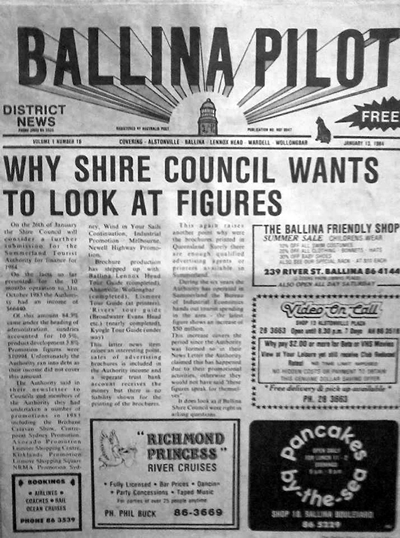
The Ballina Pilot was published as a free local paper by Diana & Max Mercer. The following biography, written by their daughter Stephanie, appears in the Heritage Study 2008.
Max and Diana Mercer moved to Ballina in 1951, with their young daughters. Diana was passionate about conservation and heritage issues and they joined the East Ballina Progress Association and were instrumental in organizing Pioneer Park – having the vision to tidy up the overgrown and neglected old cemetery and set the old headstones in the semi circle.
In 1955 they established a free weekly newspaper called ‘The Ballina Pilot’. Max used his gregarious charm to woo the advertisers. Diana wrote and edited all the copy and Stephanie and Frances [their daughters] collated, folded and delivered the paper to all houses in Ballina and East Ballina.


Diana wrote a historical novel for children called ‘Cows Can’t Eat Cedar’ based around the timber getting industry on the North Coast.
Max met with an untimely death in a car accident in 1959, then six months later Diana gave birth to her fourth daughter, Georgina. She continued to run the newspaper, raise her four daughters and pursue her community, environmental and heritage activities until 1971 when she sold the newspaper, went into semi-retirement and moved out to a property at Coolgardie which she named ‘Crystal Hill’. Like her husband before her, she met with an untimely death whilst riding her bicycle on the Pacific Highway near Wardell in 1978.
Editor’s note: The National Library of Australia hold 3 rolls of microfilm of the Ballina Pilot from 1956-1963. The Richmond Tweed Family History Society hold original copies of the Ballina Pilot 1959-1962 and the North Coast Pilot 1964-65.
The Triangle 1954 – 1974

The Triangle newspaper was started by June McMaster Yabsley in 1954. It was printed by the Northern Star and covered the districts of Coraki, Woodburn, Evans Head & Broadwater. It was a free 4-page tabloid distributed every Thursday covering local news, sports, community events, meetings, and social gossip.
In 1959 June handed over control to Jean Hartam-Bayes and photographs began to be included. It continued to be well supported by local businesses with well-designed and informative advertising. By 1965 it had increased to 8 pages and switched to being distributed on Wednesdays, increasing its area to Ballina and Byron Bay. It was still “PRICELESS” as the cover stated.
By the early 1970s, the publication had moved up to Casino with the local representative being Dorothy Robson.
The bumper 24 page March 1974 issue is the last one we have been able to locate.
This newspaper has not been digitised by Trove but instead became part of the Transcription project – more details here.


